




Project management can be quite complex depending on the industry. However, there are different methodologies that can simplify certain aspects, such as setting realistic goals. Indeed, the definition of a SMART goal and thanks to the OKR method is what will form a common thread that links your ideas to your results.
Today we enlighten you a little more on these management techniques.
SMART Goal: What is it?
To start, let’s define what a SMART goal is. It is an acronym used to talk about the attributes that a goal or objective must have. In this sense, it is therefore specific, measurable, achievable, realistic, time-bound. That is to say, it has a deadline.
These goals then offer an effective strategy by measuring the milestones and outcomes of a project. Afterwards, you will be able to set clear objectives that are best suited.
SMART goals can be defined in various areas such as project management, management, marketing but also inbound marketing.
For companies, setting SMART goals saves them time and money. By using resources wisely, anticipating and avoiding obstacles. This will lay a solid and clear foundation for better success.
The criteria for a SMART goal
- Specific : Setting precise objectives implies that the objective is not vague or too general. On the contrary, its formulation must be clear and precise. In other words, the SMART goal must be easily understandable.
- Measurable : In order to be able to define a threshold, level or value to be achieved, it must be quantified or qualified. This is called a measurable goal. This is a crucial evaluation criterion, without which it becomes impossible to deploy the appropriate means to achieve the objective.
- Achievable: To be achievable , remember to set a realistic and concrete goal. It should state not what you want to do, but what you can do. Indeed, the achievable objective must take into account the means available to the company on the one hand and the capacities of its employees on the other.
Nevertheless, it must be ambitious enough to be motivating. - Realistic : Is the objective relevant to the company’s activity? Is it justified? Is there proportionality between the resources allocated and the importance of the objective? Here questions are asked about the rationale for the specific objective. Whether in terms of profitability, image, or markets, it must be of undeniable interest to the company. That’s why you need to set realistic goals.
- Time-bound : To be effective, any concrete goal and plan must be established with timelines.
SMART Goal: Putting it into practice
Writing a SMART goal is easy when you master its 5 criteria. Just take them one by one and expand, then summarize.
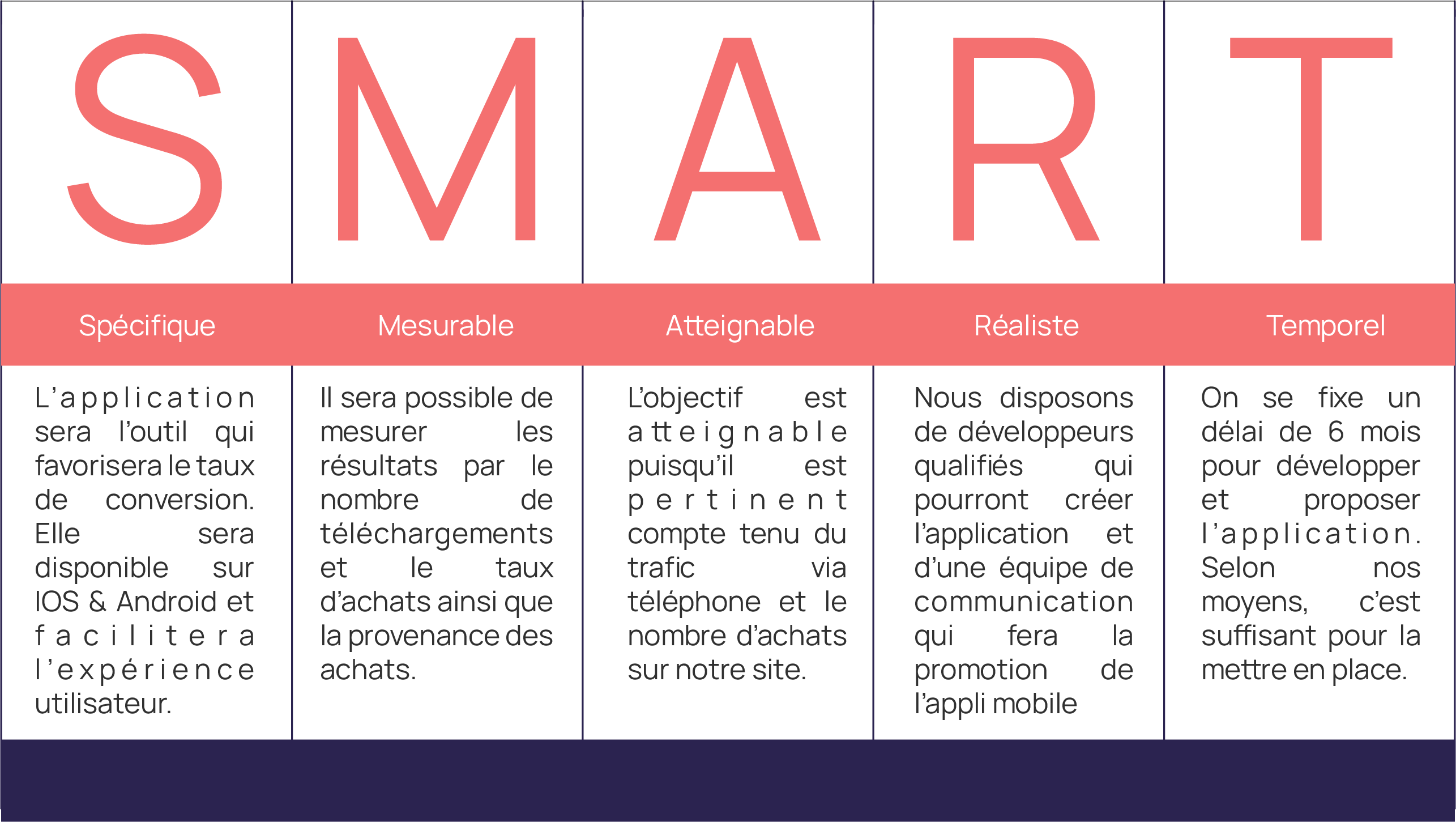
Let’s say you want to improve the user experience by offering them a mobile app. At first glance, this goal seems realistic. However, it is not SMART. In order to make it SMART, you will then have to create a table with a criterion per column, as shown below. Then, expand your main sentence as much as possible. As a result, the deadline, the means made available for the project, and the relevance of the latter will appear. Following this logic, it will move from a simple project to a specific goal ready to be implemented. So, you could define the goals that need to be achieved.
SMART Goal: How to Set Clear Goals
Examples of objectives:
- Increase shoe sales on your website by 15% with a poster campaign and a promo code in the next 3 months.
- Increase the mobile conversion rate by 25% thanks to an application that will be downloadable within 6 months. To achieve this objective, the following table must be formulated:
SMART Objective and OKR Method: The Link
The OKR methodology, Objectives and Key Results, is a business management technique whose principle is to set objectives associated with the measurement of key results. The OKR method can therefore be applied to a SMART goal. In other words, it can and should be part of the objectives of the OKR method.
In concrete terms, the OKR method consists of setting ambitious short-term goals and developing a strategy to achieve them. While the development of a SMART goal allows you to have a precise goal, the OKR method is what will end up accompanying its realization process.
OKR Basics
The OKR method answers two fundamental questions that make it possible to determine:
- What we want to accomplish.
- The means deployed to achieve this. To this we could add the indicators that allow us to know if we are going in the right direction.
In terms of analysis, all the efforts of the employees will be directed towards the achievement of the goal. The result is an optimization of the organization with a view to the realization of the project.
The Activity feature of the eBrigade software allows you to fully manage your various projects and activities.
OKR Method: Pros
At the same time, the objectives make it possible to define where we are going and to offer motivation to all staff.
But in reality, the biggest impact for companies is reflected in the changes that take place once the method is in place. As mentioned earlier, goal setting allows for the development of three essential points when using this method: focus, transparency, and alignment. Combined, these three factors lead to stronger employee engagement.
Optimization
Just like SMART goals, the goals here must be qualitative and necessarily limited in time. In addition, they must be inspiring enough and the difficulty of achieving them must be optimal, in the sense that the realization is neither too easy nor too difficult. In the first case, we risk losing interest. Whereas in the second case, when you judge that a project is quite difficult, you can end up demotivating yourself, or even abandoning it. That being said, the difficulty must be a challenge that remains realistic. Hence the interest in finding the right balance when deciding to define a goal.
Putting it into practice
The OKR method operates on several levels, namely on the scale of:
- The Company: this is the vision and/or raison d’être of the company.
- Teams: These are a team’s priorities, not a compilation of individual OKRs.
- Individual: This refers to the tasks that employees should focus on.
First of all, we must ensure that a climate of trust is well established. Without it, it will be difficult to trigger this process and motivate your employees. Since the action plan is based on autonomy, trust and good understanding are important.
In a nutshell, here are the steps you need to take to achieve your goal:
- First, define the company’s vision.
- Second, a strategy must be developed to achieve this vision.
- After that, ambitious objectives must be set, not quantified.
- Set quantified and measurable key results.
- Build work teams that can take initiative.
- Finally, measure whether or not the objectives have been achieved. To do this, regularly monitor the progress of OKRs with the manager but also with other teams.
To carry out this method, the definition and management of OKRs must have an owner within the company, named an “Ambassador”. To achieve your goals, they can bring a PowerPoint file that they will share with all the teams. It may also require them to meet the targets. Following this, it is then necessary to define new objectives.
Conclusion: the need for a SMART goal
In short, every company is led to define the objectives to be achieved.
A SMART goal is not only important for your organization, but it is a necessity. Without the establishment of a SMART objective, you cannot really start a project since it is the lever that will frame your activities. Moreover, it guarantees that these are in the interest of your entity and do not exceed its capacities.
In addition to setting a SMART goal, a company will find strength in the OKR method. It will also be able to identify your activities. Finally, it will make it possible to calculate their performance. Subsequently, she will be able to modulate her techniques and redefine the objectives to achieve her goals.
Modulating your techniques also means adapting the means used, in order to achieve your objectives. This is why we offer you the opportunity to customize the eBrigade software to the image of your structure, thanks to the various modules that are added to it.