




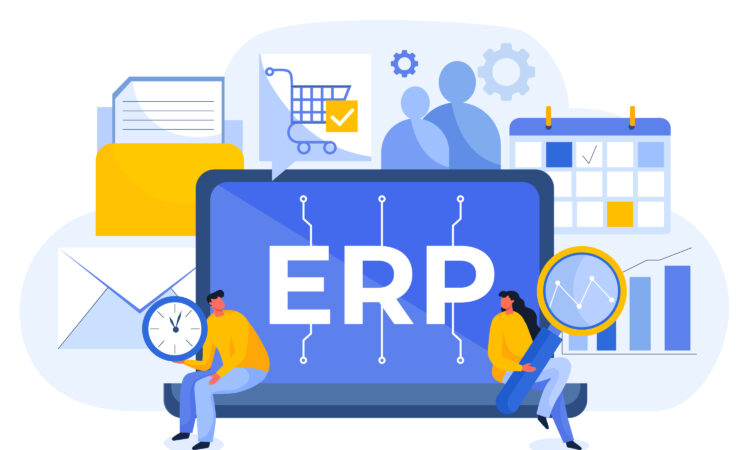
ERP stands for “Enterprise Resource Planning“. It is translated into English by the name ERP which stands for “Integrated Management Software“. But then, what does that mean? ERP is a system through which different aspects of a business are integrated into the software and help with management. Within companies of all sizes and from all sectors, ERP is at the origin of the optimization of its costs as well as its resources.
What is the purpose of the ERP?
ERP or Enterprise Resource Planning is software that allows companies to manage all aspects of their structure. The main objective is to facilitate them on these daily tasks which may require time and some organization. The different aspects on which an ERP software package intervenes can be numerous depending on the software: human resources (HR), finance, logistics , etc. This type of software is used as much in the context of SMEs as in large groups.
The whole point of business management software is that it allows you to centralize all these jobs but also to connect them to each other. This interconnectivity and data sharing is a real lever in the business world that saves a considerable amount of time , but also centralizes information so that you don’t have to spread it out over several tools.
For a good number of companies, of all sizes and in all sectors, ERP is an integral part of their daily lives and that of their activities. Indeed, the support of its many functions as well as the flexibility offered to adapt to all sectors of activity tend to please and be fully adopted.
The fields of action of an ERP
In order to optimize all the company’s processes, the ERP includes several functionalities that are specific to a business that a company structure could not do without. These features are connected to each other, share a single database, and help meet the business business needs .
From one ERP system to another, the functionalities integrated into the software can vary. In addition, ERP software can offer the possibility of having a customized system. To do this, the user company only needs to activate the features that interest it. This possibility makes it possible to give companies a response adapted directly to their needs.
Among the features that are mainly found in an ERP system, we find:
- Financial management
- Supply and inventory management
- Project management
- Production management
- Business Management
Want to get started? eBrigade is the simple and complete ERP software for your organization!
But that’s not all! An ERP can also include several modules that are complementary modules. These modules are used to enrich the optimization of the company’s resources. These modules are independent , which allows the company to activate them as needed. However, these modules are connected with the rest of the features as soon as they are activated. In particular, we can find:
- Human resources management
- CRM and customer relationship management
- Internal communication
- And many others!
These numerous modules allow the user organization to take ownership of the software. Indeed, the company benefits from configurable content that offers it a personalized response.

Human Resources, CRM, follow-up and maintenance, communication, expense reports…
What are the advantages of an ERP?
First of all, it allows companies to maintain control over the company, what is happening there but also to be able to understand why it is happening.
However, this is not the only advantage. Indeed, ERP brings the company many benefits. First, ERP makes it possible to automate certain tasks. This automation is synonymous with significant time savings for the organization, especially regarding administrative procedures. Given the delegation of certain activities to an AI (artificial intelligence), this technology makes it possible to generate reports updated in real time. From overall results to the most accurate, the company keeps track of its performance. As a result, decisions can be made quickly and are adapted to the situation. Also, as the regulatory aspect is increasingly present in the business world, the systems put in place by the ERP fully meet this and ensure total compliance.
Finally, on the employees’ side, it is also a turning point in their daily lives. Indeed, the integrated management software also acts in order to optimize their projects, whatever they may be. This includes a centralized database, which makes the work of employees more fluid, and they will know directly where to look for information. It is also the end of document exchanges between departments, everything is centralized and accessible according to predefined permissions. The productivity of the teams is then greatly improved thanks to the fluidity with which information circulates.

To discover all the features offered by the eBrigade ERP software, there is nothing better than a demo!
The installation and cost of the ERP?
What about the installation and cost of ERP software? Of course, intervening on so many tasks can have a certain cost. However, it will depend on the type of ERP deployment. Indeed, there are different types of accommodation :
- Cloud ERP
With the cloud, the ERP software is hosted on the cloud and is delivered through an internet connection. To date, cloud software is the most installed. These advantages are the cost which is reduced and its simplicity of installation.
- THE SAAS ERP
The SAAS management software is a service solution that the company can use with the internet in exchange for a subscription, a payment for its use. All the data relating to it is stored remotely, in the provider’s data center. Although it is closer to the Cloud solution, the SaaS ERP is more developed.
- On-premise ERP
As for the on-premise ERP, it is installed directly within the company’s servers. As its installation methods are more substantial, its cost can be higher.
To choose the ideal ERP for your company, many criteria, such as cost, are taken into account. Ergonomics, flexibility to adapt to your activity or the innovative aspect, all these elements are not to be neglected to make ERP software a major ally.
What we can remember
The ERP solution is a management software package that brings together a number of modules from different business lines that are interconnected with each other thanks to a single database. ERP makes it possible to meet and adapt to the current and future management needs of the company thanks to the advanced technological intelligence it requires.
Did you like this article on ERP? Share it so others can read it too and create goals of their own!
In the meantime, find us on these networks!