




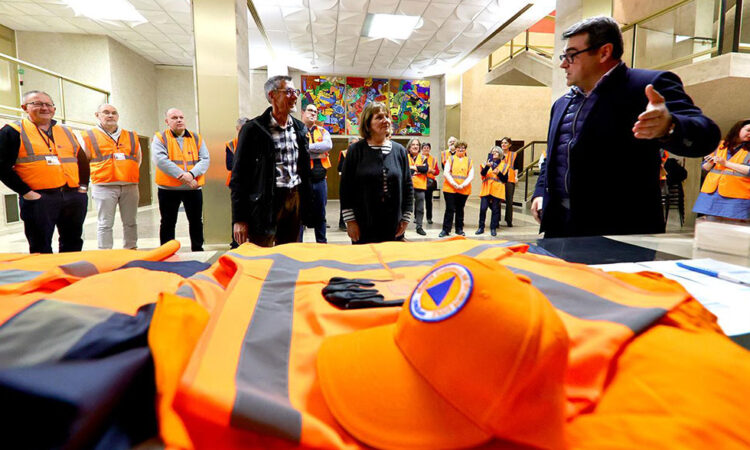
When a climatic, health or technological event occurs, the Communal Civil Security Reserve becomes one of the first operational levers available to the mayor. Its ability to quickly mobilise its volunteers determines the quality and speed of the municipality’s response.
However, even well-structured reserves face the same difficulties: dispersion of members, variable availability, lack of a centralized tool, heterogeneous communication.
In this article, we explain how a tool like eBrigade turns mobilization into an emergency situation.
The challenges of emergency mobilization
Volunteers with very variable availability
The majority of reservists have a professional or personal activity that makes their availability unpredictable. Knowing who is actually available and for how long quickly becomes complicated without a structured tool.
Dispersed means of communication
Individual calls, WhatsApp messages, manual SMS…
Communication quickly becomes chaotic:
- late responses,
- lost information,
- lack of visibility on the number of personnel that can really be mobilized.
An often incomplete view in real time
In the event of a violent storm, a snowy episode or a heat wave, elected officials and coordinators need a clear vision:
- who is mobilized,
- where the teams are located,
- what missions are underway,
- what needs emerge.
Without a digital tool, this visibility is difficult to obtain.
How eBrigade is transforming the mobilization of municipal reserves
The strength of eBrigade is to centralize all the stages of mobilization in a single platform: alert, confirmation, assignment, follow-up and reporting.
Automated notifications and confirmations
In the event of an emergency, the manager can trigger with one click:
- mobile notifications,
- SMS,
- e-mails,
- alerts in the Reservist app.
Volunteers confirm their availability immediately.
The dashboard is updated in real time, allowing you to build an operational team in a few minutes.
Instant view of people and skills
eBrigade automatically displays:
- available reservists,
- their skills (first aid, logistics, driving, population support, etc.),
- their approximate location,
- their estimated time of arrival in the area.
This transparency radically changes crisis management.
Emergency Level Management
Depending on the severity of the situation, several alert levels can be defined:
- simple standby,
- pre-mobilization,
- general mobilization.
This avoids over-reactions and allows for an organization adapted to the stakes.
Case Study: Orléans Faces a Severe Thunderstorm
To illustrate concretely, let’s take the example of a municipality affected by a localized stormy episode.
Before eBrigade: a slow mobilization
- Individual calls to reservists.
- Irregular answers.
- Lack of visibility into actual availability.
Result: 35 minutes to build a team.
With eBrigade: a fluid mobilization
- Alert sent in one click to 57 reservists.
- 24 confirmations in less than 4 minutes.
- Automatic distribution of teams according to skills.
- Real-time monitoring of missions (security, traffic, logistical support, etc.).
Result:
Team formed in 7 minutes, with better overall coordination.
Measurable benefits to the community
Significantly improved responsiveness
The municipalities generally note:
- an average mobilization time divided by 3,
- better coverage of the territory,
- Reduced errors and duplication
Enhanced coordination with partner services
Key information is centralized and accessible to:
- the municipal police,
- technical services,
- the prefecture,
- the actors of the Communal Safeguarding Plan.
A better valued reserve
With built-in statistics:
- number of missions,
- number of hours mobilized,
- available skills,
elected officials can better recognize and support the reserve.
How to Improve Engagement in 30 Days
A simple and quick process allows a municipality to transform its organization:
- Identify reservists and their skills.
- Create alert templates (rain, snow, heat wave, health crisis).
- Set up emergency levels.
- Organize a test mobilization exercise.
- Adjust the PCS based on the results.
With eBrigade, this process can be up and running in less than a month.
Conclusion
The climate and health crises are intensifying, and municipalities must be able to mobilise their reserves quickly and effectively.
With eBrigade, every community — small, medium or large — can have a modern, automated and secure system to ensure the protection of its population.