




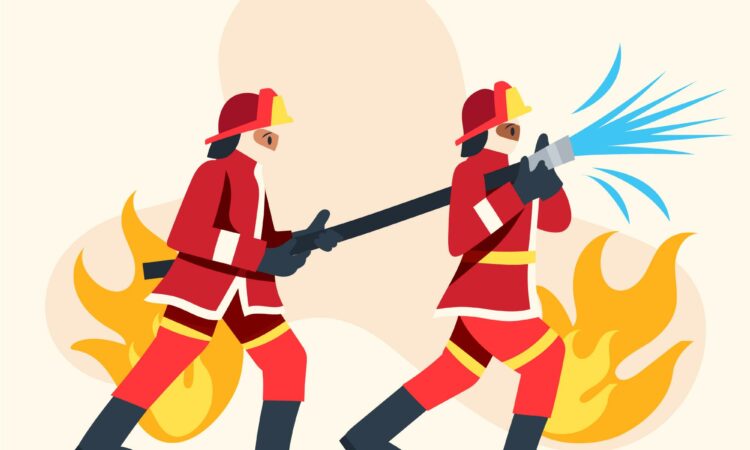
Firefighters are men and women who do their daily work: first aid. Every day, they are responsible for intervening in different missions. These missions can concern various areas: floods, pollution, fires, road accidents, etc.
Both professional and volunteer firefighters perform on-call duty. Guards are important in the life of a fire station so that firefighters are available to intervene.
To become an SPV, the candidate must meet certain conditions and have completed training. Discover the whole process with our dedicated article!
What does it mean to be on call?
On-call duty is a period of between 12 and 24 hours during which the firefighter must be present at the rescue centre and be available. Availability is important so that the firefighter is ready to intervene as soon as necessary for all types of missions. This notion of on-call duty is found in all sectors where interventions take place, such as hospitals or the police, in particular to provide the necessary assistance to people.
Within a rescue centre, the on-call service is an integral part of the main missions. Indeed, interventions are reported randomly. Without the means to anticipate them, the workforce must be ready.
For volunteer firefighters, on-call duty is also important, although the profession of first aid is one of their secondary activities.
The course of a firefighter’s on-call
Regarding the conduct of a guard, as mentioned above, the main mission of the firefighter is to be ready to intervene. When no alert is reported, the firefighter participates in the life of the station in several aspects. On the one hand, he can participate in the maintenance of equipment and vehicles. Also, the firefighter may decide to carry out training in order to maintain his physical abilities with sports exercises. For both SPP and SPV, physical activities are important in order to be able to intervene in the best conditions.
On-call duty generally takes place at non-regulatory hours, i.e. after the classic working hours of 7 p.m. to 7 a.m. The most solicited during the on-call duty are the volunteer firefighters (SPV). Indeed, this solicitation refers to their commitment as a first aid worker in parallel with their main activity. They then have a quota of minimum hours to be respected in the rescue centre. This commitment involves on-call duty between 12 and 24 hours every weekend.
Once the guard is over, the next team of rescuers takes over and a new day can begin.
eBrigade offers you the solution to fill in all your on-call rosters, in a few clicks, according to the availability and skills of each rescuer.
However, the concept of on-call duty should not be confused with that of on-call duty. The concept of on-call duty is used when a professional firefighter, as a volunteer, remains within a very limited perimeter of the rescue centre and intervenes as soon as necessary. This usually means that he can stay at home while waiting for an operation.
With the eBrigade online tool, on-call and on-call management is simple. The distribution of on-call and on-call duty is done automatically, which ensures time savings but also balance.

With eBrigade, manage and consult your staff’s on-call schedules in just a few clicks!
As mentioned earlier, interventions are among the main missions of the fire brigade. To intervene as quickly as possible, eBrigade offers its solution. On the same platform, there is the possibility of managing on-call duty, on-call duty and interventions. The geolocation of the teams closest to the perimeter of intervention saves precious time and there is the possibility of notifying them thanks to internal communication.

In real time, your teams intervene quickly and are prepared.
Did you like this article on childcare? Share it so others can read it and create goals too!
In the meantime, find us on these networks!